
Chamrol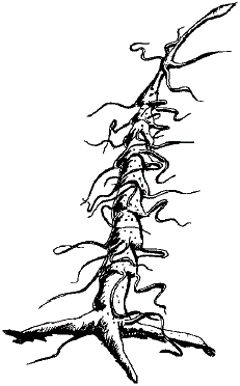
Any adventurer traveling to the border zone between the Positive Material plane and the quasi-elemental plane of Mineral will almost surely encounter one or more chamrols. These-huge creatures grow in profusion throughout this area. Possessing the qualities of plants, animals, and minerals, chamrols are encountered nowhere else, for here they can bask in the pure energy of the Positive Material plane.
A chamrol is composed almost entirely of very dense metals, mostly lead (80%); with exteriors that are studded with crystalline outcroppings. One very rare species of chamrol is composed of gold, but such types occur only 1% of the time. The chamrol's mineral roots extend deep into the minerals that permeate the entire quasi-plane. Some sages have claimed that the chamrols' roots extend all the way to the elemental plane of Earth. An average chamrol is 5d100 feet high.
Combat: The central stalk of the chamrol is coated with a covering of foliated, micalike scales. Protruding through these thin plates are dozens of writhing tentacles. Any character coming within 20' of a chamrol can be attacked by 1d6 of these tentacles, with each successful hit inflicting 1d6 hp damage. There is also a 15% cumulative chance that a successful attack enables the tentacle to grasp its victim. Anyone grabbed thereafter receives 1d6 hp constriction damage automatically for each round that he is held. The victim can attempt to break free if he makes a bend bars/lift gates roll, one roll per round; failure allows the chamrol to inflict another round of damage.
Once per day for each 100' of length, the chamrol can draw on its energy reserves to generate a tremendous bolt of positive energy. This powerful jolt, a cylinder of energy emitted from the tapered apex of the chamrol, can reach any target within 120' of the chamrol's base and affects an area 60' in diameter. Anyone caught within this area receives 2 hp damage per 10' of the chamrol's length (save vs. breath weapons to reduce damage by half). This attack is neither electrical nor fiery, so items that protect against these two effects will not help for savingthrow purposes.
Chamrols are immune to all fire and electrical attacks, but acid inflicts double damage. Only weapons of +2 enchantment or better are capable of injuring a chamrol.
Energy Pod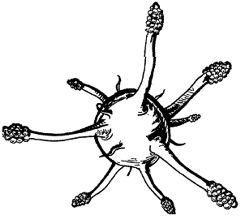
The spherical energy pod is yet another bizarre life form native to the fringe area that lies between the Positive Material plane and the quasi-plane of Mineral. Although it is mainly a native of the positive realms, this fairly large creature dwells within the border area storing energy and making occasional forays into the Mineral domains.
Combat: The stored energy is kept in the botryoidal clusters that are located at the ends of its eight stubby tentacles. Each cluster contains 6d4 nodules, all of which glow with a pulsing, lambent power. During combat, the energy pod flails with these limbs, being able to use two against each opponent in range, two opponents maximum. On a successful hit, 2d4 of the nodules burst open, each releasing a blast of positive energy. Each nodule that breaks inflicts 1d4 +2 hp damage. Once all of the nodules on a tentacle have been broken, that appendage has no effective attack.
Weapons of at least +2 enchantment are required to strike an energy pod. Since it feeds on power, the creature automatically absorbs the energy of any spells cast upon it, including spell-like effects from devices. This energy is used to create additional nodules, one per spell level absorbed. These nodules appear immediately on a random appendage (roll 1d8 to determine which tentacle).
Acid thrown on an energy pod will do double damage. The pods have no other particular resistances or vulnerabilities.
Energy pods are very rarely encountered on the Prime Material plane, almost always as guardians for magical treasures. It is also rumored that there exists a Negative Material plane creature that is a mirror image of the energy pod.
Trilling Crysmal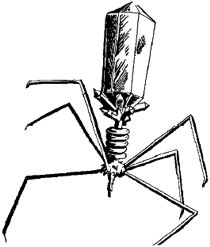
The trilling crysmal is a close relative of the crysmal and is uncommon in the elemental plane of Earth. In the quasi-plane of Mineral, however, the trilling crysmal is quite common, for here they live in great numbers, hunting along the boundary zone with the Positive Material plane.
Combat: In appearance, the trilling crysmal looks very different from a crysmal. It possesses six long, acicular legs radiating from a central crystal mass. Dominating this "body" is a huge silvery crystal almost 4' high. The entire creature is exceedingly hard, and only weapons of +2 enchantment or better can inflict damage. Lesser weapons have a 10% chance of shattering upon impact with a trilling crysmal.
The trilling crysmal has two methods of attack. The first is a slashing attack using its razor-edged legs (two at most against each opponent, engaging up to three opponents if surrounded). Each leg inflicts 1d8 hp damage. As a secondary weapon, the trilling crysmal can shoot up to six crystal barbs per day. These crystalline darts have ridged, diamond-hard edges that can penetrate the toughest of armor. Darts that successfully hit will inflict 1d4 + 1 hp damage. The darts have a range equal to a light crossbow.
Additionally, these barbs have a devastating side effect. Moments after striking an opponent, the dart shatters into 3d4 sharp splinters. These splinters cause agonizing pain that is so intense that victims temporarily lose two points of strength and four points of dexterity. Any violent movement (running, combat, etc.) that the victim performs will inflict 1d6 hp damage per round until the splinters are removed. Removal inflicts 1 hp damage per splinter, unless a cure wounds spell of any sort is used to neutralize these barbs. Such a spell will eliminate all of the splinters within any one victim.
As a special defense vs. spells cast directly on the trilling crysmal by characters or from devices, this being employs its great central crystal, Using this crystal as a double prism, this being has a 75% chance to "reflect" any spell cast directly on its body. The reflected spell will manifest in a random direction from one of the six facets (roll 1d6 and choose a "hexagonal" direction). The spells activating distance will be (1d4 X 10)+20 feet away from the trilling crysmal, affecting any creature within the spell's area of effect. This spell reflection does not influence area-effect spells (e.g., cloudkill), unless the center of such a spell is located directly upon the trilling crysmal.
